EPISODE 2 – WINNING THE CONFIDENCE
A week later, long before the first rays of sunlight reached the horizon, I found myself back on the same highway. The journey felt different this time. Last week's visit had been about asking questions and listening carefully. Today was about providing answers.
Deep down, I understood something every hunter knows. Not every pursuit ends in success. You can prepare meticulously, study every detail, and still walk away empty-handed. If today's proposal failed to convince the engineering team, I would have to rethink my approach, learn from the experience, and return with a different strategy. That possibility never discouraged me—it sharpened my focus. Confidence is not believing you cannot fail; it is knowing you have prepared so thoroughly that you are ready for whatever happens. As I drove towards the mine, I felt calm, positive, and completely prepared. The hunt was about to enter its next stage.
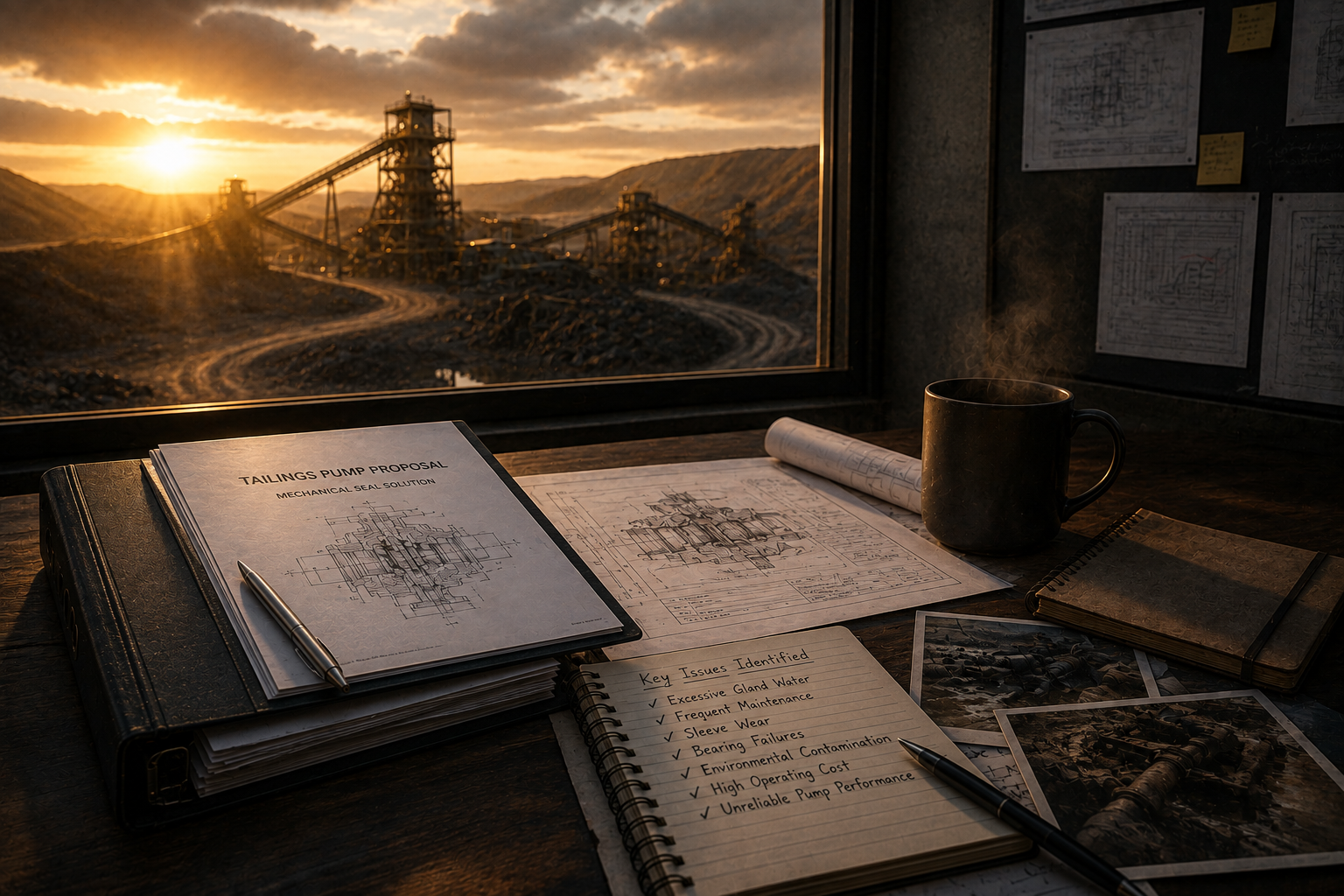
On the passenger seat beside me lay a folder containing drawings, calculations, pump data, photographs from the site inspection, and a detailed proposal. Every recommendation had been tailored specifically for this mine. There would be no generic sales presentation today.
Experience had taught me a valuable lesson over the years.
Engineers don't buy products.
They buy solutions they can trust.
By the time I reached the mine, the morning routine felt familiar. Sign the visitor register. Complete the safety checks. Collect my permit. Wait for an escort.
A small radio on the security desk quietly played the local station, its presenters chatting in the language of the surrounding tribe while traditional music drifted through the morning air. A lone chicken wandered confidently between the queue of visitors, pecking at the dusty ground as if the daily procession of hard hats and safety boots were nothing out of the ordinary. Beyond the security gate, the African bushveld stretched towards the horizon—ancient land that, over millions of years, had formed the rich mineral deposits buried deep beneath its surface. Those same minerals now sustained the mine, creating employment and opportunity for the surrounding communities. Standing there, waiting to be called through the gate, it was impossible not to reflect on the price of progress. Human ingenuity had unlocked immense wealth from the earth, but in doing so had forever altered a landscape that nature had spent countless centuries creating.
Oliver soon appeared with a smile.
"I was wondering if you'd be back."
"I said I would," I replied.
"And I don't like leaving problems unsolved."
He laughed.
"Mr. Ghomo is expecting you."
Inside the engineering office, several people had already gathered around the conference table. The engineering manager sat beside the maintenance superintendent, the plant foreman, the reliability engineer, and a maintenance planner. It was immediately clear that this decision would not rest on one person's opinion.
Everyone who would be affected by the project was in the room.
For a brief moment, I felt a familiar surge of adrenaline. There is always a difference between speaking to one engineer on the plant floor and presenting to an entire engineering panel. Years of preparation, countless kilometers on the road, and every previous success and failure had led to moments like this. I was excited by the opportunity, yet fully aware of the responsibility that came with it. Winning over a room of experienced engineers would require far more than a polished presentation—it would demand credibility, technical competence, and complete confidence in every recommendation I was about to make. I took a quiet breath, reminded myself that I knew these systems inside and out, and as the first slide appeared on the screen, the nervous energy gave way to focus. This was exactly where I wanted to be.
That was encouraging.
After brief introductions, I connected my laptop and displayed the first slide.
"I appreciate your time this morning. Last week I spent several hours inspecting your tailings plant. Today I'd like to share what I found, explain why your pumps continue to fail, and propose a solution that addresses the root causes—not just the symptoms."
The room became quiet.
I began with the photographs.
One image after another showed slurry leaking from the stuffing boxes.
Water spraying across the floor.
Makeshift conveyor-belt guards trying unsuccessfully to contain the mess.
Worn sleeves.
Scored shafts.
Bearing failures.
Maintenance records.
None of it surprised the people sitting around the table.
They lived with these problems every day.
"The leaking pumps are not your biggest problem," I said.
"The leaks are simply the evidence."
The maintenance superintendent, a stocky bald man wearing dark safety glasses, had remained silent throughout most of the presentation. As the projector illuminated the room, I couldn't help noticing the light reflecting from his polished head every time he leaned forward in his chair. His expression revealed years of working in harsh plant conditions—a man who had seen countless suppliers arrive promising miracle solutions, only to disappear when the real problems began.
When I explained that the leaking pumps were not their biggest problem, he slowly removed his glasses and fixed his eyes on me.
"What do you mean?" he asked.
His concerned voice echoed across the boardroom.
Every face turned towards me.
It was the moment I had been preparing for. The room wasn't interested in another sales pitch—they wanted an explanation that made sense. If my answer failed to convince the maintenance superintendent, I knew it would be difficult to win over the rest of the engineering team.
I moved to the next slide.
"Every liter of gland water entering these pumps eventually reports to your tailings circuit."
"That increases dilution."
"It changes slurry density."
"It increases the volume that downstream equipment must process."
"And every liter has already been treated and pumped before it ever reaches these glands."
"The reliability engineer nodded slowly.
"I found myself studying him for a moment. His neatly groomed silver-gray hair and composed manner gave him the appearance of someone who had earned every year of his experience. There was a quiet confidence about him—the kind that doesn't need to dominate a conversation to command respect. He listened far more than he spoke, weighing every statement before reacting. I had met engineers like him before. They weren't easily impressed, and they certainly didn't make decisions based on polished presentations.
"My instincts told me he was the person whose opinion carried real weight in the room. From that moment on, I made a conscious effort to keep eye contact with him as I explained each technical point. If I could satisfy the reliability engineer that the solution was technically sound, I suspected the rest of the panel would follow".
"Nobody had interrupted me yet.
"That was always a good sign.
"I continued.
""Your maintenance team adjusts packing every day."
""They replace sleeves every two weeks."
""They replace bearings every two months."
""None of these activities create production."
""They simply keep unreliable equipment running."
"The room remained silent.
"Sometimes silence is the strongest indication that people are thinking.
"I introduced the proposed sealing arrangement.
"Instead of conventional gland packing, each slurry pump would be upgraded to a heavy-duty mechanical seal supported by an external seal support system designed specifically for abrasive applications.
"The seal faces would operate without constant leakage.
"The gland water would no longer be required.
Shaft sleeves would no longer wear from packing friction.
Bearing life would improve because slurry contamination would be eliminated.
Maintenance intervals would increase dramatically.
The maintenance planner raised his hand.
"What happens if the seal fails?"
It was the question I had expected.
"A mechanical seal doesn't gradually fail the way packing does," I explained.
"It either performs correctly or it doesn't."
"More importantly, when installed correctly and operated within its design limits, seal life is measured in years—not weeks."
The engineering manager looked up from the proposal.
"How certain are you?"
I smiled.
"No engineer should ever promise perfection."
"But I can promise this."
"We've installed similar systems on pumps operating under higher pressures, higher temperatures and more aggressive slurries than yours."
"We have over twenty years of field experience, and we've learned something important."
"The seal itself is rarely the problem."
"The installation, operating conditions and system design determine whether a seal succeeds."
That answer seemed to resonate.
Too many suppliers sold components.
Very few accepted responsibility for the entire system.
Mr. Ghomo finally spoke.
Until then, he had listened with very little expression. He struck me as a no-nonsense engineering manager—a man who valued facts over promises and had little patience for exaggerated sales claims. Throughout the presentation he had spoken only when necessary, quietly observing both my proposal and the reactions of his team. It was the kind of leadership that came from years of experience.
"If we decide to proceed, what do you need from us?"
The question immediately caught my attention. Years on the road had taught me to recognise the subtle turning points in a meeting. People who have already dismissed your proposal don't ask how to implement it—they ask how much it costs, or they politely end the discussion. My instincts told me something had changed. He was no longer evaluating whether the technology could work; he was beginning to picture what it would take to make it happen. I sensed that the proposal had captured his interest, but I remained careful not to celebrate too soon. There was still work to do before the decision was truly theirs.
"If we decide to proceed, what do you need from us?"
It was the question every technical salesperson hopes to hear.
I opened the final section of the proposal.
"I'd recommend starting with one pump."
"Not all three."
The room looked slightly surprised.
"If the technology performs as expected, your own operating data will justify expanding the project."
"There is no better proof than results generated on your own plant."
The reliability engineer smiled.
"I like that approach."
"No unnecessary risk."
"Exactly."
The discussion continued for another hour.
We reviewed installation procedures.
Spare parts.
Training requirements.
Expected water savings.
Projected maintenance reductions.
Return on investment.
Every concern received an answer supported by engineering calculations rather than marketing claims.
Eventually Mr. Ghomo closed the proposal.
"I think we've heard enough."
He looked around the table.
No one disagreed.
He turned back towards me.
"We'll approve one pilot installation."
"Can you have everything ready in two weeks?"
I tried not to smile too broadly.
"Absolutely."
As we shook hands, I knew the real work had only just begun.
Winning the order was never the finish line.
It was the starting point.
Anyone can make promises in a boardroom.
The real test comes when the equipment is installed, commissioned, and expected to perform in one of the harshest operating environments on earth.
Walking back through the plant with Oliver, the atmosphere felt noticeably different. Whether it was my imagination or not, I sensed a new level of respect. We were no longer two strangers walking through the tailings plant; we were discussing the future of it.
Oliver broke the silence with a grin.
"I think you've convinced them about your reliability plan," he said. "I'm glad I don't have to fill those shoes."
We both laughed.
Then reality settled in.
I had achieved exactly what I had come for.
The engineering team had placed their confidence in me.
Oddly, I couldn't decide whether I felt relieved or burdened by the responsibility that came with it. Winning the proposal was satisfying, but it also meant that every promise I had made would soon be tested on a live production plant. There would be nowhere to hide if the system failed.
I smiled at Oliver.
"No worries," I said. "This is what I do for a living."
As the words left my mouth, I realised they weren't meant to impress him. They were reassuring me just as much. Years on the road, countless installations, and every lesson learned had prepared me for this moment. Now it was time to deliver.
We stopped beside the leaking tailings pumps once again.
Nothing had changed.
Slurry still escaped from the glands.
Water still flowed continuously.
The maintenance crew were already preparing for another round of gland adjustments.
I looked at the pumps with a sense of anticipation.
In a few weeks, one of them would become something different.
Not just another slurry pump.
A proof of concept.
Driving home that afternoon, my attention was once again drawn to the African bushveld stretching endlessly on either side of the road. The western sun was slowly surrendering its golden light to the approaching evening, bathing the landscape in colours that no photograph could ever truly capture. It was one of those rare moments that you know will stay with you forever yet can never be relived in quite the same way again.
The car radio crackled to life with "Scatterlings of Africa" by Johnny Clegg. The rhythm, the unmistakable African harmonies, and the emotion in the lyrics seemed to merge perfectly with the landscape passing my window. In moments like these, Africa doesn't simply surround you—it flows through your veins.
I was alone on the road, which meant I could sing along without worrying who might hear me. Somewhere between the chorus and the next stretch of open road, I smiled to myself.
I could have explained the success of the day to someone else—the presentation, the questions, the approval—but words alone would never have captured what I was feeling in that moment. Success was only part of it. It was the road, the bushveld, the music, the fading sunlight, and the quiet satisfaction of knowing that years of experience had opened another door. It was a moment that belonged entirely to me.
Before the song had even ended, my thoughts were already moving ahead. The proposal had been accepted; now the real engineering began. My mind was assembling installation sequences, commissioning procedures, risk assessments, tooling requirements, and contingency plans. The hunter had made the strike.
Now it was time to deliver.
I reflected on something every technical salesman eventually learns.
Technology does not change industries.
People do.
Machines do not resist change.
People do.
Before anyone believes in your product...
They first have to believe in you.